Difference Between Gas Welding Rods and Arc Welding Electrodes
Welding is one of the most important processes in metal fabrication, construction, and repair work. However, many people get confused between gas welding rods and arc welding electrodes. Although both are used to join metals, they differ significantly in structure, working method, applications, and performance.
In this detailed guide, we will explain the key differences between gas welding rods and arc welding electrodes to help you choose the right option for your welding needs.
🔥 1️⃣ Basic Working Principle
✅ Gas Welding Rods
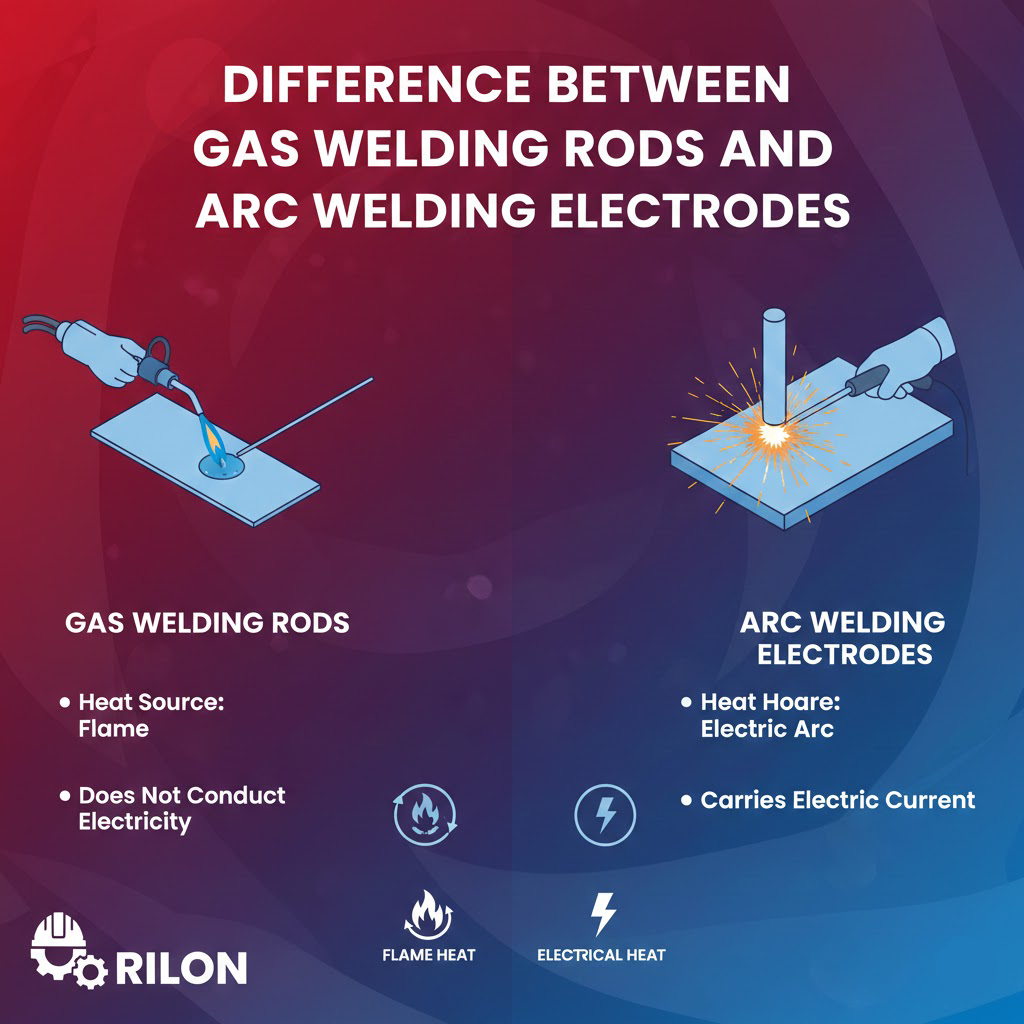
Gas welding rods are used in oxy-fuel welding, commonly known as oxy-acetylene welding. In this process:
- A flame is produced by burning oxygen and acetylene gas.
- The heat from the flame melts the base metal.
- The welding rod is manually fed into the molten pool to fill the joint.
There is no electric current involved in gas welding.
⚡ Arc Welding Electrodes
Arc welding electrodes are used in electric arc welding processes such as:
- Stick welding (SMAW)
- Shielded Metal Arc Welding
In this method:
- An electric arc forms between the electrode and the workpiece.
- The intense heat melts both the electrode and the base metal.
- The electrode acts as both filler material and conductor.
Electric current is essential in arc welding.
🧱 2️⃣ Structure & Design
Gas Welding Rods
- Usually solid bare metal rods
- No flux coating (in most cases)
- Available in different compositions (mild steel, stainless steel, aluminum, copper, etc.)
- Manually added to the weld pool
Arc Welding Electrodes
- Metal core wire
- Covered with a flux coating
- Flux produces shielding gas and slag
- Automatically melts as current passes through
The flux coating is one of the main structural differences.
🌡 3️⃣ Heat Source
| Feature | Gas Welding Rod | Arc Welding Electrode |
| Heat Source | Oxy-acetylene flame | Electric arc |
| Temperature | Moderate | Very high |
| Power Requirement | Gas cylinders | Electricity |
Arc welding generally produces higher temperatures compared to gas welding.
🏗 4️⃣ Applications
Gas Welding Rods Are Commonly Used For:
- Thin sheet metal work
- Automotive body repair
- Light fabrication
- Pipe repairs
- Artistic metal work
Arc Welding Electrodes Are Used For:
- Structural steel fabrication
- Construction projects
- Heavy machinery repair
- Shipbuilding
- Industrial manufacturing
Arc welding is more suitable for heavy-duty and structural applications.
💰 5️⃣ Equipment Cost
Gas Welding Setup:
- Oxygen cylinder
- Acetylene cylinder
- Regulators
- Torch
Initial setup can be moderate but requires gas refilling.
Arc Welding Setup:
- Welding machine (transformer or inverter)
- Electrode holder
- Ground clamp
Arc welding machines may cost more initially but do not require gas cylinders (for stick welding).
🧪 6️⃣ Weld Quality & Strength
- Arc welding usually provides stronger and deeper penetration.
- Gas welding offers better control for thin metals.
- Arc welding is more suitable for load-bearing structures.
⏱ 7️⃣ Speed & Productivity
- Gas welding is slower and more manual.
- Arc welding is faster and more efficient.
- Arc welding is preferred for large-scale industrial production.
🛡 8️⃣ Shielding Protection
Gas Welding:
- Shielding is provided by the flame environment.
- No separate flux coating required.
Arc Welding:
- Flux coating produces shielding gas.
- Slag protects the weld pool from contamination.
🧰 9️⃣ Ease of Use
- Gas welding requires more skill to control flame temperature.
- Arc welding (especially stick welding) is easier to learn for structural work.
- Beginners often start with arc welding for general fabrication.
🔍 Quick Summary of Key Differences
| Factor | Gas Welding Rod | Arc Welding Electrode |
| Power Source | Gas flame | Electricity |
| Flux Coating | Usually no | Yes |
| Best For | Thin materials | Heavy structures |
| Weld Strength | Moderate | High |
| Speed | Slower | Faster |
| Industrial Use | Limited | Widely used |